We have gone a whole week with no funerals - so that's a good thing. It seems as though our thoughts and prayers are moving to a new 'frontline': to headteachers and their staff, as they try to work out locally how to implement the Government's strategy for children to return to school next week. (Though it must be remembered that teachers have never stopped working! They have been keeping their pupils resourced with various educational materials at home, and also running local 'hubs' for children of key workers, and children 'at risk'.) This is a major headache for headteachers especially: they are caught up in a political storm for one thing; but of course their main priority is for the safety and well-being of their children and their staff, while dealing also with the concerns of many parents. Decisions have to be made in the local context. Heads try to agree on a concerted policy, to avoid confusion; they will also be constrained by logistical concerns regarding the practicalities of their own building. They need our prayers and support. I hope parents, naturally concerned primarily for their own children, will be understanding of what teachers are having to cope with.
I have been thinking about the word 'deliverance'. George VI started it for me, reading his VE Day speech in 1945, when he spoke of a 'great deliverance' at the end of the War in Europe. Deliverance presupposes there is a 'deliverer'; it also means there is a 'deliverance from' and a 'deliverance for'. King George clearly believed that God had delivered our nation from the tyranny of Nazism: he had called for a Day of Prayer in 1940 when the entire British army were trapped on the beaches of Dunkirk. Many of us pray now, for deliverance from Coronavirus - and, more than that - from all that afflicts the human race, and spoils the life God always intended for us. To believe in and know there is a God who sustains the universe, and wants only what is for our good, is a huge blessing at a time such as this.
But I am specially interested in the 'deliverance for...' question. Having been delivered, what then? For King George, this was first a matter of thanksgiving, of gratitude. I believe that thanksgiving is actually a gateway to prayer. Rather than come to God with a list of requests, it is good first to be thankful. The King went on to speak of the tasks that peace would require. There was a nation to be rebuilt - and a world. The immediate post-war years were times of severe austerity, but also times of significant re-formation. The NHS itself, of course, was one of the outcomes. I wonder what benefits will emerge from this latest deliverance.
Currently, our morning Bible readings take us through St Luke's Gospel. Here, the first significant 'mighty work' that Jesus does is the deliverance of a man who had an evil spirit. (What this means in today's language of mental and spiritual health, we don't know.) What interests me is, 'What happened next?' As so often in the Gospels, we are not told! But I would love to think that this man, now delivered, went on to live a life which was happy, fulfilled, and profoundly thankful.
We are taught by Jesus to pray, 'Deliver us from evil.' What evil do we desire to be delivered from today? And how will we use our new freedom, when that prayer is answered?
Monday, 18 May 2020


Monday, 4 May 2020
Living with Viruses
We are now completing 6 weeks of lock-down. For many of us, a whole new routine and way of life has developed, from which we will eventually emerge - with more disruption, I guess. So our thoughts turn to the future. We are fortunate that the leadership in our diocese is devoting itself to considering the future of 'Church' here: we have recently had papers from both bishop and archdeacon inviting us to reflect on this. Finance and buildings inevitably will feature largely, but the bigger questions have to do with how we understand Christian witness, ministry and mission today and tomorrow. Some would say that another 'fault line' (geologically speaking) which the present crisis has revealed is the apparent irrelevance of Church for much of society. This is not news, but it has become clearer.
For me, the beginning and end of this debate is the 'old news' that God has entered the world in the person of Jesus Christ, and the first call on the life of every Christian is to 'follow him.' Like Peter, who tries to walk on water, if we pay too much attention to the wind and the waves around us, we're sunk!
I've been thinking about viruses. I'm absolutely not a scientist so anything I'm about to say is open to question! According to my dictionary, a virus is a corrupting or infecting influence. (There's a much longer scientific definition too, which I can't begin to understand!) But, from a little research, it is clear to me that viruses are - quite literally - a part of life. Some biologists describe them as a 'life form', and one particular description fascinates me: they are organisms at the edge of life. This being so, maybe the language of battle is not quite appropriate - pace my recent quotation of C.S. Lewis. For one thing, it suggests a rather arrogant attitude on the part of humanity, that we can be conquerors of all we survey. For another, it is foolish to think that we can defeat or eradicate something which, scientists, believe, have always been there. I also understand that it is possible to harness viruses for good, in the treatment of various diseases - and this, I believe, is the foundation of vaccination.
We are told that COVID-19 will be around for along time. So if this is about waging war, we will be exhausted. If, on the other hand, we are patient and think in terms of living with, while protecting ourselves from the virus, we will stand a much better chance of living well. Perhaps a good illustration of this comes from computing, where we are aware of viruses and the need to have good anti-virus software. (Let us not discuss here the question of the origins of viruses - whether in nature or in computer software!) We need to protect our computers from these invasions, but once we have done so we can get on with the business of using these machines well. But think about how we react if we are hacked, or if something goes wrong! Anxiety, panic, anger. All negative emotions, which can prevent us from thinking sensibly about how to deal with the problem.
In the end, it's about humanity's desire, even expectation, to be in control. And if there is one thing we are learning now it is that actually we can't be. Not completely. So we need to live more humbly, and tread more carefully upon the good earth. So the ancient words of the prophet Micah come to mind: what does God require? To do justly, to love mercy, to walk humbly with God.
So I continue to pray daily: Peace (in the face of fear) and Protection (from all that harms us) for all. As one of my favourite theologians, Stanley Hauerwas has put it, We all want to get out of life alive!
Here is another offering from Eleanor: the rainbow of hope over Cockermouth.

For me, the beginning and end of this debate is the 'old news' that God has entered the world in the person of Jesus Christ, and the first call on the life of every Christian is to 'follow him.' Like Peter, who tries to walk on water, if we pay too much attention to the wind and the waves around us, we're sunk!
I've been thinking about viruses. I'm absolutely not a scientist so anything I'm about to say is open to question! According to my dictionary, a virus is a corrupting or infecting influence. (There's a much longer scientific definition too, which I can't begin to understand!) But, from a little research, it is clear to me that viruses are - quite literally - a part of life. Some biologists describe them as a 'life form', and one particular description fascinates me: they are organisms at the edge of life. This being so, maybe the language of battle is not quite appropriate - pace my recent quotation of C.S. Lewis. For one thing, it suggests a rather arrogant attitude on the part of humanity, that we can be conquerors of all we survey. For another, it is foolish to think that we can defeat or eradicate something which, scientists, believe, have always been there. I also understand that it is possible to harness viruses for good, in the treatment of various diseases - and this, I believe, is the foundation of vaccination.
We are told that COVID-19 will be around for along time. So if this is about waging war, we will be exhausted. If, on the other hand, we are patient and think in terms of living with, while protecting ourselves from the virus, we will stand a much better chance of living well. Perhaps a good illustration of this comes from computing, where we are aware of viruses and the need to have good anti-virus software. (Let us not discuss here the question of the origins of viruses - whether in nature or in computer software!) We need to protect our computers from these invasions, but once we have done so we can get on with the business of using these machines well. But think about how we react if we are hacked, or if something goes wrong! Anxiety, panic, anger. All negative emotions, which can prevent us from thinking sensibly about how to deal with the problem.
In the end, it's about humanity's desire, even expectation, to be in control. And if there is one thing we are learning now it is that actually we can't be. Not completely. So we need to live more humbly, and tread more carefully upon the good earth. So the ancient words of the prophet Micah come to mind: what does God require? To do justly, to love mercy, to walk humbly with God.
So I continue to pray daily: Peace (in the face of fear) and Protection (from all that harms us) for all. As one of my favourite theologians, Stanley Hauerwas has put it, We all want to get out of life alive!
Here is another offering from Eleanor: the rainbow of hope over Cockermouth.

Tuesday, 28 April 2020
Reflecting on Funerals
We are coming to the end of something of a run of funerals. Between us we have had 12 in 10 days. Some of these have been deaths caused by Cv, and others not; some unknown, in that they weren't tested. Numbers have now declined, suggesting that - as nationally - the Cv peak is past. For now, anyway. On the whole, people have followed the requirements of minimum numbers of mourners, and social distancing. These have made for some very different funerals from the ones we have been used to.
This year, I will have been a vicar for 45 years. I was shocked to find, from a very rough calculation, that I must have taken close on to 3000 funerals! It is true that, as a vicar, you develop your own ways of doing things, but I can honestly say that every funeral for me has been different, unique. Because each person is. I have therefore tried to ensure that each service is be properly prepared for and offered, as a way of commemorating that life and holding them before God. Whether he or she knew it or not, their life was God-given and they were loved from beginning to end - and beyond. And every service is as much about the family and friends, as it is about the deceased. Even now, I find I will vary a service, include new material, as appropriate for the occasion. Don't tell the bishop, but I don't stick much to the set order of service!
So it has not been difficult for me to adapt to the latest regulations. In some ways, these smaller, shorter, quieter funerals have been better in their own way. Yesterday, I did a burial at one of our most beautiful churchyards, and I overheard one of the mourners say she had actually preferred it to the more traditional way: the whole service conducted outside, in warm sunshine, in a more intimate gathering. (It would, of course, have been a very different matter in the depths of winter!) I think it can assist the family if their grief is more private, rather than before a mass of extended family, friends and well-wishers - much as their love and support is appreciated. Then, as many families are proposing, if a big thanksgiving/memorial service is planned for later on, they may be more ready to celebrate the life of their loved one, being further along the journey of grief.
It is quite common these days for a family member or friend to offer a tribute, to reminisce about the person who has died. In the context of a smaller gathering this has a greater poignancy: on two or three occasions lately, as the speaker has fought back their tears, family members have called out words of encouragement to help them through. That would be less possible in a crowded church or crematorium chapel, where a certain amount of decorum is required.
Another thing that has happened, because not many are allowed to attend a funeral, is that people have come out onto the streets in town or village to applaud, or stand in respectful silence as a funeral cortege has passed by. I understand this used to happen far more in former times, than now. But the custom could return - though it is more possible at the moment with more people being at home. It is also a special way of expressing community.
Come the autumn, some vicars will be very busy taking memorial services, I think! Although not all families will want a religious aspect to their remembering. It will be interesting to see which of these new funeral practices become customary in future.
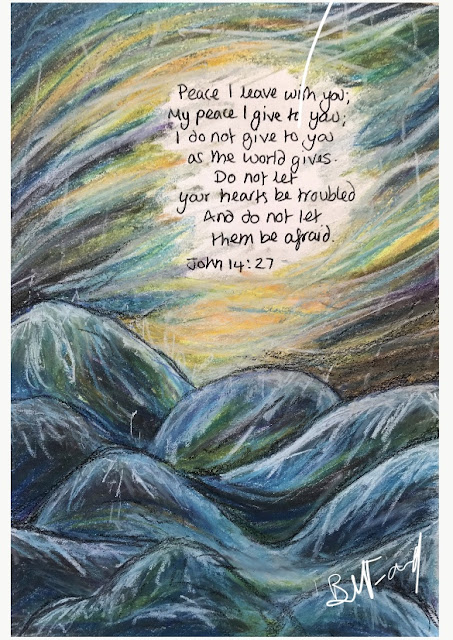
Today's piece of art comes from Becky, who lives in Sheffield. The words are words of Jesus. Becky comments, I drew this picture the first day my brother was in hospital last week... I have often seen this Bible verse illustrated with tranquil scenes, but I feel that the peace that Jesus gives us is especially precious when we’re in the middle of the storm.
This year, I will have been a vicar for 45 years. I was shocked to find, from a very rough calculation, that I must have taken close on to 3000 funerals! It is true that, as a vicar, you develop your own ways of doing things, but I can honestly say that every funeral for me has been different, unique. Because each person is. I have therefore tried to ensure that each service is be properly prepared for and offered, as a way of commemorating that life and holding them before God. Whether he or she knew it or not, their life was God-given and they were loved from beginning to end - and beyond. And every service is as much about the family and friends, as it is about the deceased. Even now, I find I will vary a service, include new material, as appropriate for the occasion. Don't tell the bishop, but I don't stick much to the set order of service!
So it has not been difficult for me to adapt to the latest regulations. In some ways, these smaller, shorter, quieter funerals have been better in their own way. Yesterday, I did a burial at one of our most beautiful churchyards, and I overheard one of the mourners say she had actually preferred it to the more traditional way: the whole service conducted outside, in warm sunshine, in a more intimate gathering. (It would, of course, have been a very different matter in the depths of winter!) I think it can assist the family if their grief is more private, rather than before a mass of extended family, friends and well-wishers - much as their love and support is appreciated. Then, as many families are proposing, if a big thanksgiving/memorial service is planned for later on, they may be more ready to celebrate the life of their loved one, being further along the journey of grief.
It is quite common these days for a family member or friend to offer a tribute, to reminisce about the person who has died. In the context of a smaller gathering this has a greater poignancy: on two or three occasions lately, as the speaker has fought back their tears, family members have called out words of encouragement to help them through. That would be less possible in a crowded church or crematorium chapel, where a certain amount of decorum is required.
Another thing that has happened, because not many are allowed to attend a funeral, is that people have come out onto the streets in town or village to applaud, or stand in respectful silence as a funeral cortege has passed by. I understand this used to happen far more in former times, than now. But the custom could return - though it is more possible at the moment with more people being at home. It is also a special way of expressing community.
Come the autumn, some vicars will be very busy taking memorial services, I think! Although not all families will want a religious aspect to their remembering. It will be interesting to see which of these new funeral practices become customary in future.
Today's piece of art comes from Becky, who lives in Sheffield. The words are words of Jesus. Becky comments, I drew this picture the first day my brother was in hospital last week... I have often seen this Bible verse illustrated with tranquil scenes, but I feel that the peace that Jesus gives us is especially precious when we’re in the middle of the storm.

Tuesday, 21 April 2020
Caring for Carers
It's been a fairly full few days: the anticipated increase in funerals has happened. Between us we have 12 in the space of 10 days. They are not all apparently Cv related, in the sense that this was given as the cause of death. However, one of our local undertakers surmised that some elderly, frail people may have simply lost the will to live, in the current crisis. Or, as he put it, 'Cv has tipped them over the edge.' Not impossible. I'll write another time about funerals, and the changes of practice caused by the Cv lock-down.
Another thing that has preoccupied me over the weekend is a submission to our bishops concerning 'The Church in Cumbria after Lock-down'. Our diocesan leaders are spending some time considering the implications for church life of this crisis - some of it actually quite positive e.g. better use of technology; some of it less so, notably a significant drop in income, exacerbating some already challenging financial concerns.
While I was a student, I spent one long vacation as an 'auxiliary nurse' at a geriatric hospital. It was an education! Since then, of course, I have visited countless homes for the elderly, either to see individuals or to conduct some kind of worship service. Both my parents spent their final years in care homes, and currently my aunt is a resident at a care home in London. A friend and colleague here is manager of such an establishment locally. I am also aware that I am becoming 'elderly' myself, and the time may not be too far off when I might need such care. So, at least at second-hand, I have some knowledge of and an interest in residential care.
The Cv crisis is proving to be something of a litmus test of different aspects of our society. In many ways, we are recognising our strengths: the selfless dedication of NHS staff, and the very many acts of kindness and neighbourliness, for example. But we are also seeing where the gaps are. It is no surprise to find that residential care is one of these. For years, successive governments have failed to address the issue of care for the elderly. Cuts in local government budgets have made the situation worse, and it has been left to the private sector, by and large, to try to meet the needs. Care home staff are poorly paid in comparison with other workers, revealing how as a society we fail to recognise the importance of the job they do. The same is true of those who care for the elderly in the community.
It is probably inevitable that we will all face tax rises when the crisis is over. Is it too much to expect that a proportion of that increase will go towards care for the elderly? And will we all be prepared to pay for this? After all, it is a fact that the age profile of our country is getting older. The need is urgent.
Another thing that has preoccupied me over the weekend is a submission to our bishops concerning 'The Church in Cumbria after Lock-down'. Our diocesan leaders are spending some time considering the implications for church life of this crisis - some of it actually quite positive e.g. better use of technology; some of it less so, notably a significant drop in income, exacerbating some already challenging financial concerns.
While I was a student, I spent one long vacation as an 'auxiliary nurse' at a geriatric hospital. It was an education! Since then, of course, I have visited countless homes for the elderly, either to see individuals or to conduct some kind of worship service. Both my parents spent their final years in care homes, and currently my aunt is a resident at a care home in London. A friend and colleague here is manager of such an establishment locally. I am also aware that I am becoming 'elderly' myself, and the time may not be too far off when I might need such care. So, at least at second-hand, I have some knowledge of and an interest in residential care.
The Cv crisis is proving to be something of a litmus test of different aspects of our society. In many ways, we are recognising our strengths: the selfless dedication of NHS staff, and the very many acts of kindness and neighbourliness, for example. But we are also seeing where the gaps are. It is no surprise to find that residential care is one of these. For years, successive governments have failed to address the issue of care for the elderly. Cuts in local government budgets have made the situation worse, and it has been left to the private sector, by and large, to try to meet the needs. Care home staff are poorly paid in comparison with other workers, revealing how as a society we fail to recognise the importance of the job they do. The same is true of those who care for the elderly in the community.
It is probably inevitable that we will all face tax rises when the crisis is over. Is it too much to expect that a proportion of that increase will go towards care for the elderly? And will we all be prepared to pay for this? After all, it is a fact that the age profile of our country is getting older. The need is urgent.
Thursday, 16 April 2020
Learning from History (2) - and some more art
Reflecting on yesterday's brief historical examples, what might we learn about today's experience?

- This is a moment for self-examination. (Plague) examines the mind of the human race. To think about what matters and what doesn't. How do we prioritise? How much do we appreciate one another, and the world of nature? Are we prepared to put the needs of others before ourselves? As someone has emailed me just today: I hope that when things do eventually return to some sort of normality, we have learnt from this time and are able to pace ourselves more appropriately and... consider the important things in life. The birds are a constant reminder for me to do this... they now appear so happy and loud in this time of quietness.
- The need to care for our sick, dying and otherwise needy people. This might seem obvious in an advanced society such as ours, but the current debate about the treatment of our elderly in residential care - and how we value (or don't) our care workers - highlights a much neglected area in our country. It is said that a mark of a healthy society is the way it cares for its weakest members. Care and compassion have always been qualities central to Christian mission: as St Cuthbert demonstrated.
- We need to learn to accept our vulnerability - that we are not in control. This lies behind the quotations from Martin Luther, who casts himself on God's mercy.And if we have a proper estimate of ourselves, in all humility, we are more likely to be kind to others.
- Luther also demonstrates a wonderful common sense for the common good! I shall avoid places and persons where my presence is not needed...Social distancing in the 16th century!
- Fearless in the face of death, courageous in the face of suffering. Someone said to me recently that the fear around at the moment is not so much fear of the virus, it's fear of death. And here particularly is the Christian contribution. Once we realise that by his death Christ has destroyed death, and by his rising he has raised us to life eternal - and once, by faith, we have received this most precious of gifts, then we can enter more fully into the darkest places. Times like these, as Spurgeon pointed out, are when churches tend to grow, and people turn to God: the mind is sensitive... when death is abroad.
- In all the examples I quoted previously, there was a sense that those who did what they did for the sake of Christ gained many admirers. One writer attributes the growth of the Church in the 3rd century largely to the way Christians sacrificially gave themselves to care for the sick and the dying. Although we now have our wonderful NHS, with all the wonders of modern medicine and technology to help and heal the sick, we all know that it is the character of the individual doctors and nurses which really leaves an impression. And it is the character of Christians in any walk of life which is the best commendation of our Lord, especially in times of fear and instability.
Here is another piece of artwork from Heather: an Easter 'offering'. The picture doesn't really do it justice, as there is shimmering gold thread in there!

Wednesday, 15 April 2020
Learning from History (1) - and 'How the Virus Stole Easter'
We invested a lot of time and energy in the various online services last week. So it's a bit quieter this week - though not a lot! I've found that several of us are doing a bit of a stock-take. What are we learning? What will the future look like, for church and society? Frankly, we have little idea at present. If recent predictions are fulfilled about continuing social distancing and face masks, this will have a profound effect on how we 'church'. Will the common cup at Communion ever return, for example?
We are inclined to forget that 'plagues' have had a very significant impact upon social history for many centuries. Countless millions of lives have been lost to them. For example, 20 million to the influenza pandemic which probably hastened the end of World War 1. 'Plague' is probably too loaded a word to use today, but that is surely what we are experiencing? It's interesting to note some Christian reflections on previous pandemics. Here are just a few:
We are inclined to forget that 'plagues' have had a very significant impact upon social history for many centuries. Countless millions of lives have been lost to them. For example, 20 million to the influenza pandemic which probably hastened the end of World War 1. 'Plague' is probably too loaded a word to use today, but that is surely what we are experiencing? It's interesting to note some Christian reflections on previous pandemics. Here are just a few:
- There was a lethal pandemic across the Roman Empire in the middle of the 3rd Century. It is estimated that some 5000 people per day were dying in Rome. Bishop Cyprian of Carthage (c.200-258 AD) wrote: How suitable, how necessary it is that this plague and pestilence, which seems horrible and deadly, ...examines the mind of the human race; whether the [healthy] care for the sick, whether relatives dutifully love kinsmen as they should . . . whether physicians do not desert the afflicted. Christians at the time won a lot of admiration for their fearless caring for the sick and dying, often resulting in their own deaths. As another contemporary bishop (Dionysius of Alexandria) wrote: Many, in nursing and curing others, transferred their death to themselves and died in their stead. That sense of pandemics 'examining the mind of the human race' is certainly a thought to ponder.
- In the so-called Celtic period in Britain (roughly 600-800AD), plagues were common: sometimes whole villages would be wiped out. St Cuthbert (see my blog, 20th March) became Prior of Melrose Monastery, because the previous prior died from the plague. He himself succumbed, but recovered - walking with a limp for the rest of his life. We read that when he went out on mission, preaching the Gospel, he cared for many plague victims and healed some of them.
- From the 14th century, in Europe, there were frequent outbreaks of the bubonic plague - known as the Black Death, because the flesh of sufferers turned black. One such outbreak happened in 1527 in Wittenberg, home of Martin Luther, the great church reformer, and his wife Katharina, who was pregnant at the time. Luther wrote, We must respect the word of Christ, “I was sick and you did not visit me.” According to this passage we are bound to each other in such a way that no one may forsake the other in his distress but is obliged to assist and help him as he himself would like to be helped. Writing about his own strategy, he said, I shall ask God mercifully to protect us.Then I shall fumigate, help purify the air, administer medicine and take it.I shall avoid places and persons where my presence is not needed so I don't become contaminated and thus accidentally pollute others and so cause their death as a result of my negligence. If God should wish to take me. He will surely find me, and I have done what He has expected of me. What a wonderful combination of faith, pragmatism and social distancing!
- There was a similar outbreak in London in 1665, from which the city was largely delivered by the Great Fire the following year. Perhaps most remarkable that year was the story of the village of Eyam in Derbyshire, where 80% of the population perished. However, in a wonderful example of 'self-isolation', led by the Vicar, William Mompesson, the villagers decided not to flee so as not to infect others. Mompesson's wife died in the plague, but he himself survived, preaching in the open air Sunday by Sunday until it was over.
- In 1854, there was a terrible outbreak of cholera in London - by then probably the wealthiest and most powerful city in the world. A youthful Charles Spurgeon, later to become a well-known Christian preacher and writer, reflected thus:If there ever be a time when the mind is sensitive, it is when death is abroad. I recollect, when first I came to London, how anxiously people listened to the gospel, for the cholera was raging terribly. There was little scoffing then. Like other Christian leaders before him, he recognised a pandemic as a time when people are more receptive to the Christian Gospel because it faces the reality of death head-on.
In summary, what may the reflections and experiences of those who have gone before us teach us as we think about church and society in the future? I will return to this later.
Meanwhile, here is a poem from South Africa, which picks up the theme I mentioned two days ago: comparing empty churches with the Empty Tomb.
|
|
Sunday, 12 April 2020
Not the Easter we planned
We had such big plans for Easter this year. A big procession of witness through the town on Good Friday, with one of our bishops, and featuring several parts of the Passion story in costume drama. We had been planning this for months. Still, nothing wasted - it will keep till next year! Big thanks to all who had been working so hard on this.
Then today we would have begun with a dawn service on the field, down by the river in town, around a massive cross we would have planted at the end of the procession. Then, after worship in our several churches, there was going to be a Festival of Faith, including baptism and confirmation with the bishop returning to Cockermouth. Alas, for the several candidates, that will have to wait a few more weeks. Like lots of other things.
So the weekend has been remarkably quiet, though there has been some preparation to do: I did (twice) a live Communion service on Zoom this morning from our living room. We had over 20 at the dawn service - when we would have been on the field. And more than that later in the morning. So joyful worship - apart - with a strong sense of our unity in the risen Christ.
We have still managed to erect a cross in the town; and also here in Broughton (see below): done, of course, as part of someone's daily exercise!
Church buildings were empty today - but as someone has pointed out, so was the tomb on the first Easter Day. It doesn't mean nothing was happening. Jesus was out and about, heading for Galilee, where most of his mission took place. He was going to meet his friends there. Just so, the church wasn't inactive either. All day, I have been hearing and reading things about what different churches up and down the country have been doing to celebrate Easter. There have been many 'meetings'. My guess is that more people have been participating than would have been in a church service anyway!
I hope yours has been a good Easter Day. Happy Easter. And may the joy of this day carry forward to another 'day of resurrection' tomorrow!

Then today we would have begun with a dawn service on the field, down by the river in town, around a massive cross we would have planted at the end of the procession. Then, after worship in our several churches, there was going to be a Festival of Faith, including baptism and confirmation with the bishop returning to Cockermouth. Alas, for the several candidates, that will have to wait a few more weeks. Like lots of other things.
So the weekend has been remarkably quiet, though there has been some preparation to do: I did (twice) a live Communion service on Zoom this morning from our living room. We had over 20 at the dawn service - when we would have been on the field. And more than that later in the morning. So joyful worship - apart - with a strong sense of our unity in the risen Christ.
We have still managed to erect a cross in the town; and also here in Broughton (see below): done, of course, as part of someone's daily exercise!
Church buildings were empty today - but as someone has pointed out, so was the tomb on the first Easter Day. It doesn't mean nothing was happening. Jesus was out and about, heading for Galilee, where most of his mission took place. He was going to meet his friends there. Just so, the church wasn't inactive either. All day, I have been hearing and reading things about what different churches up and down the country have been doing to celebrate Easter. There have been many 'meetings'. My guess is that more people have been participating than would have been in a church service anyway!
I hope yours has been a good Easter Day. Happy Easter. And may the joy of this day carry forward to another 'day of resurrection' tomorrow!

Subscribe to:
Posts (Atom)